The BirdCast
B I R D S A N D B I R D S A N D B I R D S A N D B I R D S A N D B I R D S.
What it is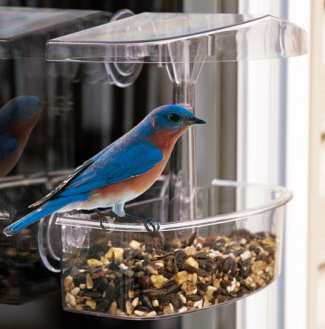
This is a live feed of my window feeder, which is a bird feeder that is suction-cupped to my window. Birds come and go regularly for seed to eat. Various birds including Goldfinches, Chickadees, Cardinals, Finches of various kinds will appear at the feeder and you will be able to view them IN HD! :D
Indigenous birds to this region that you will be able to see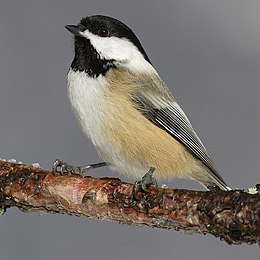 Black Capped Chickadee
Probably one of the most frequent birds in Canada. The Black-capped Chickadee (Poecile atricapillus) is a small, North American songbird, a passerine bird in the tit family Paridae. It is the state bird of both Maine and Massachusetts in the United States, and the provincial bird of New Brunswick in Canada. It is notable for its capacity to lower its body temperature during cold winter nights, its good spatial memory to relocate the caches where it stores food, and its boldness near humans (they can feed from the hand).
It's call sounds sort of like
Chicka-chicka-dee-dee-dee. They can also be heard singing a soft faint
hee-hoooo. American Goldfinch
Another very frequent bird, they tend to come in pairs. The American Goldfinch (Carduelis tristis), also known as the Eastern Goldfinch and Wild Canary, is a small North American bird in the finch family. It is migratory, ranging from mid-Alberta to North Carolina during the breeding season, and from just south of the Canadian border to Mexico during the winter.
The only finch in its subfamily which undergoes a complete molt, the American Goldfinch displays loveual dimorphism in its coloration; the male is a vibrant yellow in the summer and an olive color during the winter months, while the female is a dull yellow-brown shade which brightens only slightly during the summer. The male displays brightly colored plumage during the breeding season to attract a mate.
It's call sounds similar to a Canary, letting out
Tee-hehehee while flying, and various squeaks and calls while seated.
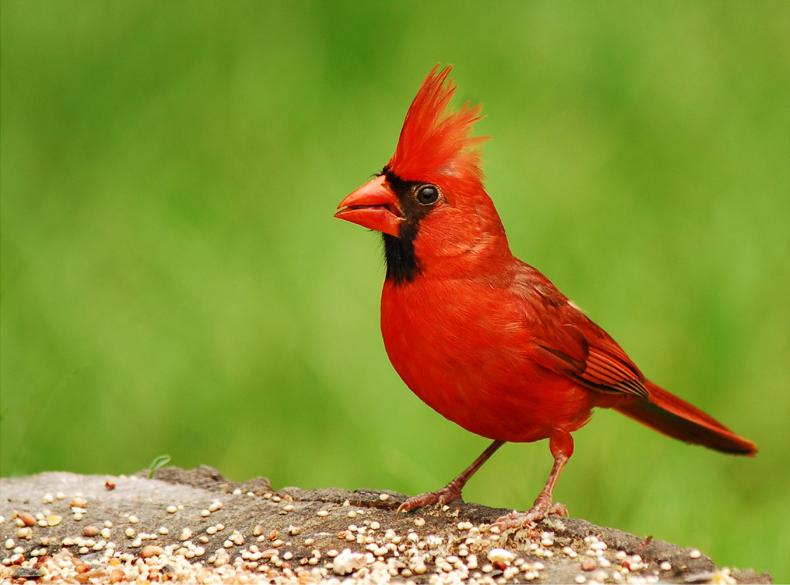 Northern Cardinal
Very rare, but possible, to get this in the feeder. The Northern Cardinal (Cardinalis cardinalis) is a North American bird in the genus Cardinalis; it is also known colloquially as the redbird or common cardinal. It can be found in southern Canada, through the eastern United States from Maine to Texas and south through Mexico. It is found in woodlands, gardens, shrublands, and swamps.
The Northern Cardinal is a mid-sized songbird with a body length of 21 centimeters (8.3 inches). It has a distinctive crest on the head and a mask on the face which is black in the male and gray in the female. The male is a vibrant red, while the female is a dull red-brown shade. The Northern Cardinal is mainly granivorous, but also feeds on insects and fruit. The male behaves territorially, marking out his territory with song. During courtship, the male feeds seed to the female beak-to-beak. A clutch of three to four eggs is laid, and two to four clutches are produced each year. It was once prized as a pet, but its sale as cage birds is now banned in the United States by the Migratory Bird Treaty Act of 1918.
It's song is sort of like a
what-cheer, what-cheer... wheet, wheet, wheet, wheet and it echoes very loudly. They also let out a very loud
Pip! wherever they are, while flying, or while eating, or while doing whatever.
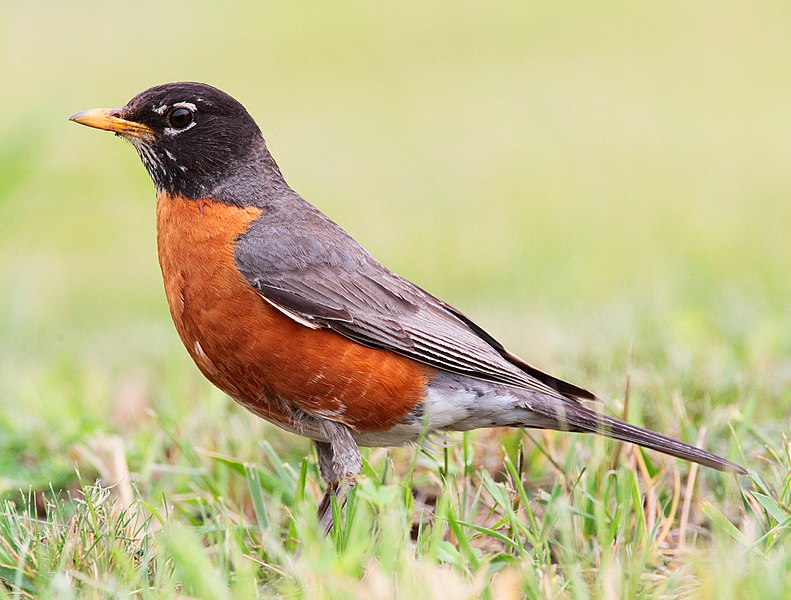 American Robin
You probably will never see this at the feeder, but the American Robin tends to chill nearby, it has a nest on my deck. The American Robin or North American Robin (Turdus migratorius) is a migratory songbird of the thrush family. It is named after the European Robin because of its reddish-orange breast, though the two species are not closely related, with the European robin belonging to the flycatcher family. The American Robin is widely distributed throughout North America, wintering south of Canada from Florida to central Mexico and along the Pacific Coast. It is the state bird of Connecticut, Michigan, and Wisconsin. It has seven subspecies, but only T. m. confinis in the southwest is particularly distinctive, with pale gray-brown underparts.
The American Robin is active mostly during the day and assembles in large flocks at night. Its diet consists of invertebrates (such as beetle grubs, earthworms, and caterpillars), fruits and berries. It is one of the earliest bird species to lay eggs, beginning to breed shortly after returning to its summer range from its winter range. Its nest consists of long coarse grass, twigs, paper, and feathers, and is smeared with mud and often cushioned with grass or other soft materials. It is among the first birds to sing at dawn, and its song consists of several discrete units that are repeated.
The adult robin is preyed upon by hawks, cats and larger snakes, but when feeding in flocks, it can be vigilant and watch other birds for reactions to predators. Brown-headed Cowbirds lay eggs in robin nests (see brood parasite), but robins usually reject the cowbird eggs.
Robins will make a
PEEK!! tut tut tut tut... warning call when threats are nearby. Its song is commonly described as a
cheerily carol, made up of discrete units, often repeated, and spliced together into a string with brief pauses in between.


